Copy trading slippage can help explain why a copied trade opens at a different price from the provider’s trade. But a gap between two account results is not automatically slippage. Spreads, position sizes, trading costs and missing trades deserve separate checks. This guide gives MT4 users a practical way to investigate the difference without mistaking a provider’s track record for their own expected return.
The aim is a clear execution audit: identify what happened, collect comparable records and ask specific questions before changing anything. The seven checks below apply to a review process; the available controls depend on your broker and copying software. MetaQuotes’ built-in Signals service is one example, not a description of every third-party copier.
In this guide
What copy trading slippage actually means
For this review, slippage means the difference between a requested execution price and the price actually received. A provider-to-follower fill difference measures something slightly different: the gap between two separate executions. If you only have account statements, call it a fill difference rather than claiming you have measured the broker’s precise order slippage.
A higher entry price is less favorable for a buy; a lower entry price is less favorable for a sell. A favorable difference can also occur. Entry and exit need separate treatment because the direction of the transaction reverses when a position closes. A percentage return alone cannot tell you which part of the execution chain caused a difference.
A clearly hypothetical price example
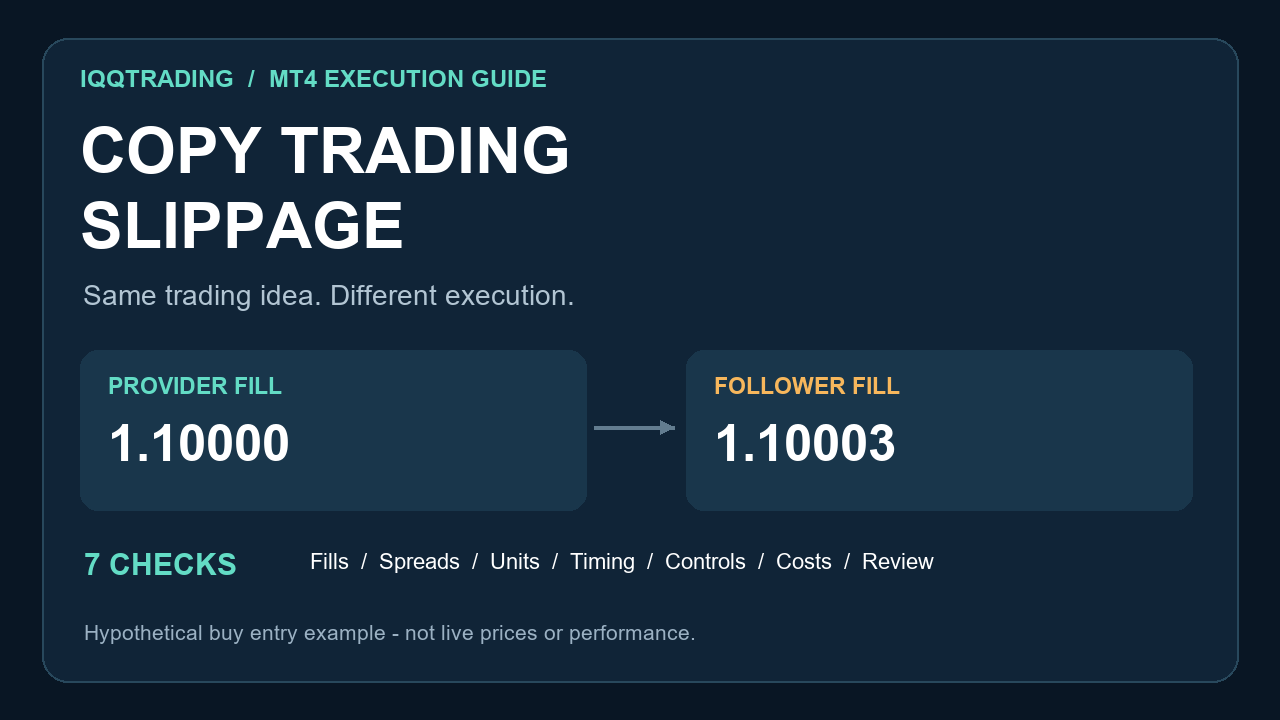
Suppose a provider buys EUR/USD at 1.10000 and a follower buys at 1.10003. The follower’s entry is 0.00003 higher. On a five-decimal quote where one point is 0.00001, that is three points. Under the usual EUR/USD convention of one pip being 0.0001, it is 0.3 pip. These invented prices illustrate arithmetic only; they are not market quotes, account performance or a statement about IQQTrading execution.
For a sell entry, reverse the comparison: a lower follower fill is less favorable. Do not convert this price gap into a cash loss until you know the actual position size and contract specification. The provider’s fill is a useful comparison price, but it is not necessarily the price requested by the follower’s software.
1. Match the trades before comparing results
Build a private comparison sheet with one row per matched trading decision. Record the symbol, direction, provider entry and exit, follower entry and exit, volume, costs and time zone. If a copier splits an order or closes part of a position, document that relationship rather than treating each ticket as an unrelated trade.
Separate matched closed trades from unmatched trades and positions that remain open. Otherwise, your comparison may mix execution quality with different exposure. MT4’s Account History and Trade tabs serve different purposes; the former does not include open positions. The official terminal guide describes these views and the Journal and Experts logs used for investigation. [S004]
2. Separate spreads from copy trading slippage
The spread is the difference between Bid and Ask. It is not the same measurement as the difference between a requested price and a fill. MT4 also distinguishes buy and sell prices when sending market orders, so comparing a chart level with a fill without identifying the relevant price side can be misleading. [S002] [S003]
Ask whether both accounts use the same symbol and account type. If you have time-stamped Bid and Ask records, keep them beside the fill records. If those quotes were not recorded, mark the spread at execution as unknown. Today’s spread cannot establish what was available when yesterday’s order was executed.
3. Check symbol specifications and price units
In MT4, inspect the instrument’s specification through Market Watch. Verify quote digits, contract details, tick size and any relevant trading constraints for both accounts. MetaQuotes documents these specification fields; a familiar symbol name alone does not establish identical trading conditions. [S003]
This matters especially when comparing gold symbols or broker-specific suffixes. Write the unit explicitly in your worksheet: price difference, platform points, or a defined pip convention. A bare statement such as “five pips of slippage” is difficult to audit when nobody has stated what a pip means for that instrument. Keep the original prices as well as the converted figure.
4. Review timing and connection records
Record the sequence you can actually verify: provider execution, receipt by the copying system, follower order request and follower execution. Not every platform exposes every timestamp. Normalize time zones, distinguish second-level from millisecond-level records and avoid claiming a precise delay from rounded statement times.
For MetaTrader’s built-in Signals service, the subscribed terminal must remain connected to receive and copy trades. Other copying systems can use different architectures, so check their own documentation. A VPS may address a local availability problem, but it does not prove that prices or results will match. [S001]
MT4’s Experts and Journal tabs can help locate messages and trading events. Save relevant entries privately and redact account identifiers before sharing screenshots publicly. Look for a repeated pattern across comparable records; one unusual trade is a starting point for investigation, not enough evidence to rank execution quality. [S004]
5. Understand the copier’s execution controls
Find out exactly which system you use before adjusting a deviation setting. The built-in MT4 Signals documentation expresses its Deviation/Slippage control as a multiple of the current spread and describes retry and re-synchronization behavior. Do not assume an EA-based copier uses that same unit or policy. [S001]
MQL4’s OrderSend reference also documents requested prices, execution errors and a slippage parameter. That does not make a copier’s tolerance setting a universal guarantee of a particular fill. Ask the supplier how your specific broker execution mode, rejected requests and retries are handled. [S002]
Treat a missed trade as its own event. A price filter that rejects an entry may leave the follower with different exposure from the provider. Widening a tolerance merely to make every trade copy can change the risk you accept. Keep a record of the current configuration and investigate the cause before making changes.
6. Compare volume and net trading costs
Two accounts can have similar entry prices and different monetary outcomes because they used different volumes or paid different costs. Reconcile gross trading profit, commission and swap separately, and check the broker statement’s sign conventions. Keep subscription charges outside trade-level execution calculations unless you explicitly label a separate all-in service-cost comparison.
If you compare percentage returns, define the calculation and treatment of deposits, withdrawals and open positions. A closed-trade subtotal does not establish equity drawdown. For the wider account-sizing question, read how account size affects trading risk. This execution guide addresses a different question: which recorded differences explain the two accounts’ outcomes?
7. Turn the evidence into a useful review
For each matched trade, label entry differences and exit differences separately. Count missing trades, rejected requests and incomplete records alongside the matched sample. State the observation period and sample size. If a field is unavailable, retain “unknown” instead of filling the gap with an estimate that looks like a measurement.
Review patterns by instrument, session and direction where the records support that breakdown. A simple average can hide a small number of large adverse differences, while a sample of completed trades can hide failures to copy. Those are reasons to inspect the underlying rows, not a promise that any particular statistic predicts future execution.
Questions to send to your service provider
Ask: Which price did the follower request? Which unit does the deviation setting use? Were there retries, symbol-mapping issues or rejected orders? How are partial closes matched? Which costs are included in the displayed result? A short question tied to a specific redacted trade record is more actionable than asking why two headline percentages differ.
Applying the checks to your trading setup
When reviewing the IQQTrading copy trading service, use your own account records and confirm the settings available for your arrangement. This guide makes no claim that IQQTrading accounts have any particular slippage, return or execution speed.
For the software side, Tramaxis trading software development is a related resource for trade copier and integration requirements. Define the evidence you need before evaluating a technical solution: symbol mapping, clear units, event logging and documented error handling. Confirm actual capabilities with the supplier; a development service is not proof that an existing account has those features enabled.
The useful outcome of a copy trading slippage review is a documented explanation of observed differences. Preserve your risk limits while investigating, and judge your own results separately from the provider’s history. This is educational information, not personalized investment advice. Leveraged trading can cause substantial losses, and past results do not guarantee future performance.
Sources and further reading
Technical documentation checked on October 20, 2026. The checklist and hypothetical calculation are editorial explanations, not measured trading results.
[S001] MetaTrader 4 Help: Signal Subscribers
[S002] MQL4 Reference: OrderSend
[S003] MetaTrader 4 Help: Contract Specification
[S004] MetaTrader 4 Help: Terminal